
Progressive Farmer Progressive Farmer
Your Country Home and Family Horses and Farm Animals Farm Fresh Gardens Outdoors and Wildlife You Can Do It Projects Landowner Know-How Farming As A Business

Farming as a Business

What Turner Owns

Kansas:
2. Z Bar Ranch. 38,000 acres along Oklahoma border.

Montana:
3. Bar None Ranch. Turner's first foray into the West in 1987. Bar None is 23,000 acres.
4. Flying D Ranch. Beautiful 113,000-acre property southwest of Bozeman on the way to Yellowstone National Park.
5. Snowcrest Ranch. 13,000-acre property near Alder. 6. Red Rock Ranch. 5,000 acres near Dillon.

New Mexico:
7. Ladder Ranch. 155,000 acres located west of Truth or Consequences.
8. Armendaris Ranch. 360,000 acres located east of Truth or Consequences.
9. Vermejo Park. Massive 580,000-acre 1996 acquisition gives Turner well over 1 million acres in New Mexico alone.

Nebraska:
10. Spikebox Ranch. Western Nebraska ranch of 54,000 acres.
11. Deer Creek Ranch. 49,700 acres in western Nebraska.
12. McGinley Ranch. 69,000-acre ranch with some overlap into South Dakota.
13. Blue Creek Ranch. 78,870 acres purchased this year.

South Carolina:
14. Saint Phillips Island. 5,000-acre island near Beaufort in area known as The Low Country.
15. Hope Plantation. 5,500 acres near Jacksonboro.

South Dakota:
16. Bad River. 138,310-acre acquisition of what were 13 separate ranches.

Argentina:
17. LaPrimavera and two other ranches. More than 128,000 acres.

This Land Is Ted's Land
From Montana to Nebraska to New Mexico and beyond, Ted Turner has purchased more swaths of rural real estate than anyone else.
E-mail this article Printer-friendly

This Land is Ted's Land
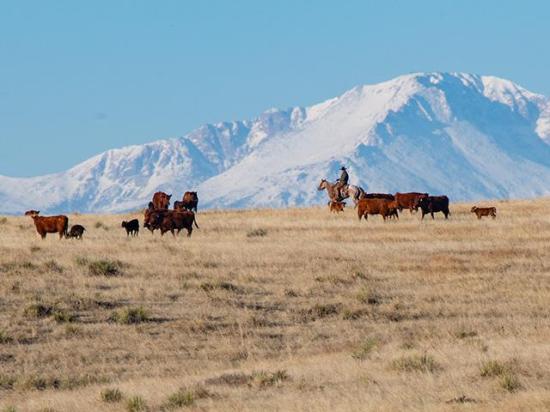
The Flying D's alpine terrain isn't optimal bison country. Historically, the animals would have ranged over even larger areas on the Great Plains.
Vann Cleveland
"Why, land's the only thing in the world worth working for, worth fighting for, worth dying for, because it's the only thing that lasts." --Gerald O'Hara, "Gone With the Wind"

Ted Turner has obviously taken his favorite line from his favorite movie (which he owns) to heart.

The colorful, controversial media billionaire and environmentalist now owns 1.7 million acres, mostly ranchland, in the U.S. He owns more land than any other individual in the U.S.

His 2,600-plus square miles would cover more than half the state of Connecticut. And the buying, which began in earnest 13 years ago, isn't over. In the past year alone, Turner has purchased roughly 320,000 acres in Kansas, Nebraska and South Dakota.

Even if all 13 of his major Western holdings cost him $20 million apiece, and they didn't, that's $260 million spent. Turner, the vice-chairman and largest shareholder of Time Warner, is worth $7 to $10 billion on any given day, depending on the stock's price.

Most of his holdings are ranches and farms in New Mexico, Montana, Nebraska, Kansas, South Carolina, Florida and South Dakota. Many acres are devoted to providing pasture for Turner's expanding 23,600 head of bison, easily the largest herd in the world.

About 4,900 bison roam the 113,000-acre Flying D Ranch near Bozeman, Mont. Turner, 61, spends most of his summers at the secluded and modest (by billionaire standards) log home tucked into a hillside above a 14-acre man-made lake.

It was there that we had breakfast with Turner. Russ Miller, the general manager of Turner's far-flung ranching operations, met us early in the morning near the Flying D's main gate to lead us in.

Long before we see Ted Turner, we hear him. As we stand in the dining room, the unmistakable voice buzzes loudly from an interior office and master suite, where the founder of the CNN and TNT cable networks is on a business call. Something about several hundred thousand dollars, then some sharp profanity from Turner.

Miller smiles at us and suggests we wait out on the deck. No problem. The deck affords a stunning view of the Spanish Peaks to the south. Several hundred buffalo can be seen moving in the distant pastures.

Listening to Turner at breakfast, then later on the deck, it's apparent that his land acquisitions are about more than just bison. He outlines a rough agenda to keep as much of his land in a natural state where wildlife, as well as bison, can thrive. His properties are rife with experiments� �� ��often in conjunction with federal wildlife officials� �� ��to help endangered species, such as black-footed

ferrets, Mexican gray wolves and red-cockaded woodpeckers.

Further, the Flying D and Bar None ranches in Montana have been placed in conservation easements to forever prevent their development.

[PAGEBREAK]

Turner says he has thought about bison since he acquired buffalo-head nickels as a wildlife-obsessed little boy.

As an adult with some money, Turner did something about his fantasies. "When I got my first piece of property in South Carolina 20 years ago, I got three bison," Turner says. "A bull and two cows. I daydreamed about having a thousand of them� �� ��as far as the eye could see."

Now, because that dream has been checked off the list, Turner has decided that bison might actually turn a profit. He doesn't, of course, have to count on it.

"Bison may be more profitable than cattle right now, but so were ostriches once," he says. "The market can collapse anytime because it's an exotic specialty item."

Turner has hedged his bets by joining the North American Bison Cooperative based in New Rockford, N.D.

"I think, overall, the perception of Ted among our 270 members is positive," says Dennis Sexhus, executive director of the North American Bison Cooperative. "His presence is good. It lends confidence to people that he chose to join us."

Turner is sold on the cooperative idea, citing what producer groups such as Ocean Spray cranberries have done.

"Before, bison were marketed without standards," says Turner. "Producers were selling mature animals as prime that were tough. For a restaurant to put bison on the menu, you have to have a reliable source of supply and quality standards like beef has," he says.

The transition from buffalo hobbyist to bison businessman hasn't come without a learning curve.

Take fences, for instance. When he first bought the Flying D in 1989, Turner had more than 250 miles of fencing torn out. He had a utopian vision of bison and other animals roaming in a fence-free, as-near-to-natural 90,000-acre setting as possible.

Wrong.

What they found out was that bison, like cattle, tend to overuse riparian areas near streams and ignore some upland regions.

So some fencing came back, beginning in 1997. The 90,000 acres is now divided into five pastures.

Turner also has had to adjust his environmental sights in terms of weed control. Pockets of the Flying D have been overrun with leafy spurge, a scourge in the West.

"I'll be very candid about it," says Miller. "Most people can't afford to do what we do with noxious weeds." The annual budget for weed control on the Flying D alone (much of it spent on the chemical Tordon) is more than $100,000. "We are working with biological and research projects to wean ourselves away from chemicals," Miller is quick to add.

"To (Turner's) credit, he spends a ton of money on weed control," says John Youngberg, director of member relations with the Montana Farm Bureau. He then adds, "You can be very environmentally sensitive when you have an unlimited pocketbook."

If their ability to spray as much as they do along fencelines helps their neighbors, Miller is glad for it. There was more than enough suspicion in the area to go around when Turner bought the Flying D and brought in bison.

"I think our neighbors know what we are about now," says Miller. Roland Moore runs cattle on his 4,000-acre Cold Springs Ranch adjoining the Flying D. He says Turner Enterprises has been a good neighbor. "I've had more cows on Ted Turner's land than he's had bison on mine," says Moore. "It was no big deal when I couldn't get some animals off his property for a couple of days once. They were very good about it."

Continued herd expansion means more land. "Right now we have the capacity for close to 20,000 mother cows," Turner says. "And we're still looking for large ranches that can be efficient."

That was the case with the Z Bar Ranch, a 38,000-acre spread in south-central Kansas along the Oklahoma border that Turner bought last year.

Hutchinson realtor Doug Wildon, who handled the sale, says he has nothing but praise for the professionalism of Turner's operation. "They are good neighbors. They are straight shooters. They aren't going to hurt anything, and they aren't going to take property off the tax rolls," he says.

Although ranch efficiency is important, it's clear that Turner's primary interest is in trying to establish and maintain natural wildlife in a sustainable ranching operation.

Coming up a draw on the Flying D, Russ Miller pulls his pickup to a halt when a herd of elk is spotted on a ridge 300 yards to our left. At least 20 animals are moving away from us. Earlier, we had spotted an even larger group.

Most, but not all, of what the elk consume from pastures is recouped through an annual hunt on the ranch. Thirty hunters pay $10,000 apiece to spend a week trying to bag a bull elk� �� ��no guarantees, just the opportunity.

Turner also allows an elk cow hunt on the ranch, through a drawing of area residents, at no charge. As many as 1,750 hunters have participated annually.

That most of his properties will end up in trusts and foundations and the fact that someone like Turner can outbid full-time ranchers for land doesn't sit well with many folks.

"My opinion, really, is that these easements are long-term acquisitions by the government," says Pat Goggins, one of the state's best known cattlemen, who has taken issue with Turner on several occasions. "It may take 50 years� �� ��after his family is gone� �� ��but eventually I believe that's what will happen."

Turner shakes his head when he hears this kind of talk. "I don't know why anybody in the ag business would be worried about easements," he says.

"Basically, when you put easements on, you guarantee the land will stay in agricultural practice. It's something you do voluntarily."

As for the long-term future of the land, even Ted Turner admits some helplessness. "It's hard to dictate what happens 100 years from now."

That's not to say he isn't trying.

Editors Note: Progressive Farmer magazine is part of Southern Progress Corp., which is owned by Time Warner, Inc.

Print  
Advertising Info Idea House and Farmstead Farms $ Land For Sale Farmers Market The Best Places to Live